There’s a narrow window in any construction project when insulation is cheap, easy, and permanent to get right — and it closes the day the drywall goes up.
If you’re building a custom home in Kleinburg, adding a second storey in Woodbridge, or putting an addition on the back of a Vaughan home, the spray foam decisions you make while the walls are open determine how the finished space performs for the next thirty years. Get them right during framing and they cost a fraction of what they’d cost later. Miss them and the fix means demolition.
Here’s what belongs in foam during construction, and what doesn’t.
Why “during construction” changes everything
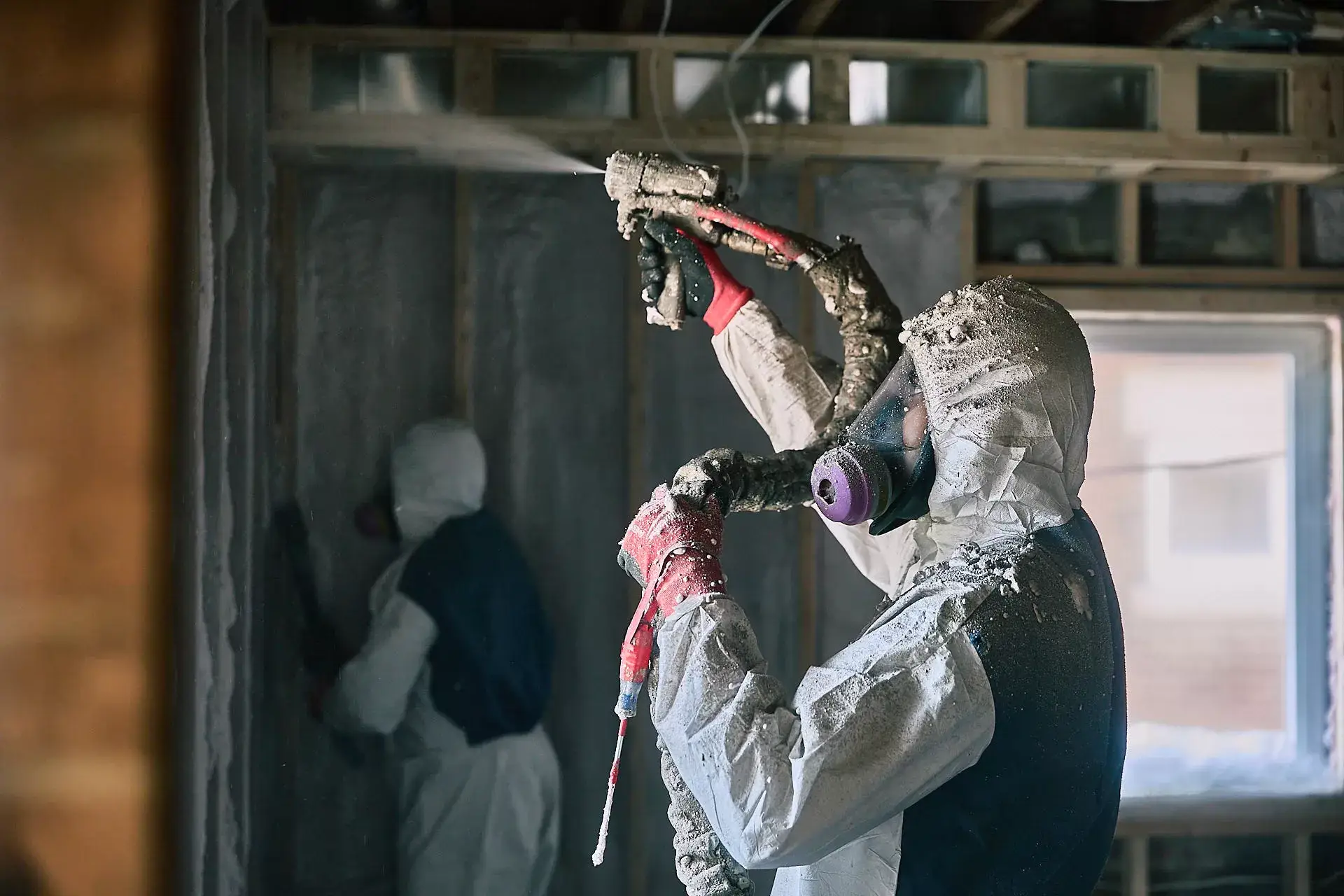
Once framing is open, every cavity, cavity edge, rim joist and junction is exposed and reachable. Spray foam can be applied to all of it in one pass, sealing and insulating at the same time, before anything is closed in.
After drywall, the same work means opening walls back up. The cost difference isn’t small — it’s the difference between a scheduled trade during the build and a demolition-and-repair project afterward.
This is why the decision has to be made now, not deferred. “We’ll deal with insulation later” is one of the most expensive sentences in a renovation.
The two products, and when each belongs
| ½ lb open-cell | 2 lb closed-cell | |
|---|---|---|
| Approx. R per inch | ~R-3.5 – R-3.8 | ~R-6.0 – R-7.0 |
| Structure | Soft, flexible | Rigid, dense |
| Own vapour barrier? | No | Yes, at sufficient thickness |
| Moisture | Absorbs water | Resists water |
| Sound dampening | Better | Poorer |
| Cost | Lower | Higher |
In a new build or addition, both have a place:
- Closed-cell where moisture and R-per-inch matter: below grade, rim joists, cathedral and shallow roof assemblies, cantilevered floors, garage ceilings, anything against exterior conditions.
- Open-cell for interior sound control and air sealing above grade where moisture isn’t a factor — a cost-effective way to quiet a home full of rooms.
½ lb open-cell → · 2 lb closed-cell →
Where foam earns its place in a new build or addition
1. Cathedral ceilings and shallow roof assemblies
Custom Vaughan homes love a vaulted primary suite or a great room open to the roofline. These have limited cavity depth, so R-per-inch is everything — closed-cell delivers roughly double what batts do in the same space, and seals the many rafter junctions that would otherwise leak. Getting this right during framing is far easier than any retrofit.
2. The walkout or below-grade basement
Vaughan’s estate lots and sloped sites produce a lot of walkout basements — part above grade, part below, often intended as finished living space from day one.
Below-grade walls need insulation and moisture control. Closed-cell foam applied to the foundation delivers both in one pass and keeps the framing on the warm, dry side. Framing and filling with batts against a foundation wall, without a sound vapour strategy, is how mould appears behind finished drywall a few winters later — and in a basement built as living space, that’s an expensive failure. Vapour barrier installation →
Basement walls carry their own rebate (up to $1,500 on the bundled path).
3. Rim joists and cantilevers
Every new floor structure has a rim joist around its perimeter — a continuous air-leak point unless sealed. And custom homes are full of cantilevers: bump-outs, projecting bays, second-storey overhangs. Both are trivial to foam while open and problematic to reach later. Closed-cell seals and insulates them, and blocks the cantilever joist bays so outside air can’t track back under a heated floor.
The rim joist is also one of the cheapest qualifying rebate measures ($300 on the bundled path).
4. The garage ceiling under living space
If your build or addition puts a room over the garage — near-universal in Vaughan’s larger homes — spray-foaming the garage ceiling during construction is the moment to prevent the cold-floor problem that plagues finished homes. Closed-cell in the joist cavities, then 5/8″ fire-rated drywall (required between garage and dwelling). Doing it now costs a fraction of the tear-out-and-redo that fixes it later. Garage ceiling insulation →
5. Whole-envelope air sealing on the finished build
For a large custom home, AeroBarrier seals the entire envelope at once at a measured, verified air-tightness level — applied at the right stage of construction. On a big, complex home where hand-sealing every penetration is impractical, it’s the most reliable way to hit a real air-tightness target, and it qualifies under the rebate program’s air sealing measure.
Where foam isn’t the answer, even in a custom build
Being straight about this matters more when someone’s spending on a whole house.
The main attic. If your build has a standard vented truss attic with headroom — most do — blown-in reaches R-60 for far less than foaming the roof deck. Foaming the underside of the roof to create a conditioned attic is a legitimate choice with real benefits (especially if HVAC lives up there), but it’s a big spend, and for most Vaughan homes with mechanicals in the basement, blown-in to R-60 is the better value. Decide this deliberately, not by default. Attic insulation in Vaughan →
Interior partitions where you only want sound. Open-cell foam or acoustic mineral wool does sound better and cheaper than closed-cell. In a custom home, plan sound isolation room by room — primary suite, home theatre, office, gym — while the walls are open. Safe and Sound →
Standard above-grade exterior walls where batts plus good air sealing suffice. Foam is better; “better” and “worth the premium on every wall of a 5,000 sq ft house” are different questions. Spend the foam budget where moisture and shallow cavities make it necessary; use batts plus proper sealing where they don’t.
As a substitute for solving water or ventilation. A walkout with a drainage problem needs the drainage fixed first — foam over an active leak hides it. A home sealed tight without adequate mechanical ventilation will have humidity and air-quality issues. In a new build, ventilation isn’t optional; it’s part of the design.
Practical questions
We’re building — when does the foam go in? After rough-ins (electrical, plumbing, HVAC) and inspections, before insulation inspection and drywall. Your builder or our team coordinates the timing; the key is that it happens at the open-wall stage.
Do occupants need to stay away? On an active construction site this is usually a non-issue since no one’s living there yet. In an occupied-home addition, we install Insulthane Extreme by Elastochem, residents can generally remain, and we’ll discuss ventilation and re-entry for the specific area. Flag any respiratory sensitivities in advance.
Does closed-cell need a separate vapour barrier? At sufficient thickness it acts as its own. It’s assembly-specific and stated on the quote — important to coordinate with your builder so you’re not paying for redundant poly.
Can we do insulation and drywall together? Yes — insulation, vapour strategy, sound, and drywall on one scope. On a build or addition that removes a handoff between trades and a gap in accountability.
Does new-construction insulation qualify for rebates? The rebate program is aimed at existing homes; a brand-new build occupied six months or less is excluded, and new construction is governed by code minimums rather than retrofit rebates. An addition to an existing, occupied home is a different case — worth checking eligibility for the specific measures. Vaughan rebate details →
⚠️ Program terms change — confirm at homerenovationsavings.ca.
How we quote a build or addition
- Review the plans and the site — assemblies, roof design, below-grade walls, garage, cantilevers. On new construction we work from drawings and coordinate with your builder.
- Specify product and thickness per assembly — open-cell or closed-cell, applied inches, stated so it’s comparable to other bids and coordinated with your vapour strategy.
- Fixed price, staged to the build schedule.
- We’ll tell you where foam isn’t worth it and quote blown-in, batt or mineral wool for those areas. We install all of them.
📞 (416) 315-0471 · Book a free assessment →